Unlock the potential of precision measurement with Biometrics Ltd's advanced accelerometers. Our sensors offer a comprehensive solution for capturing acceleration in three axes, catering to both static and dynamic applications, thus enabling you to understand motion and vibration in the most detailed way possible.
Precision 3-Axis Sensors
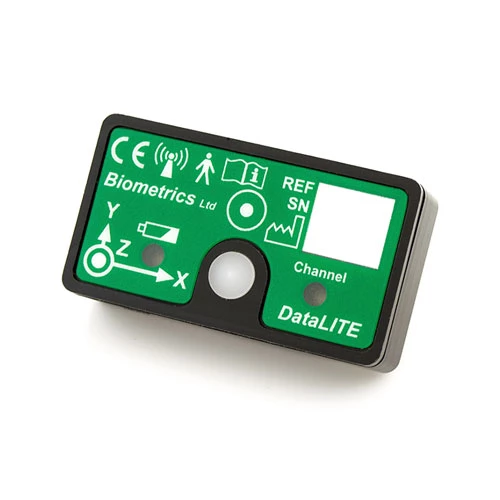
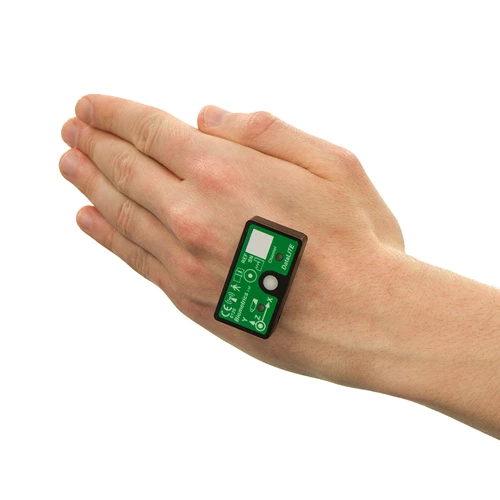
Enjoy the freedom of wireless data acquisition with our ACL500 Accelerometer. It delivers precise measurements of both dynamic and static accelerations. Its extended battery life ensures up to 12 hours of uninterrupted data collection, and a range of up to 30 meters from the interface allows for a flexible setup in various environments.
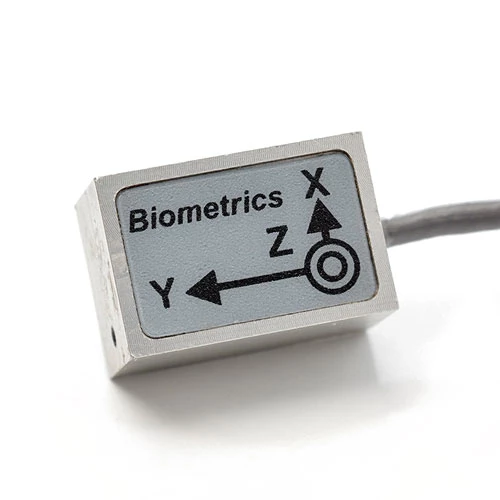
Our wired ACL300 Accelerometer is your versatile companion for a wide range of research applications. Its adjustable low pass filter settings and scalable full-scale measuring range mean you can tailor the device to your specific research needs, capturing the most relevant data with precision and ease.
Industrial Strength
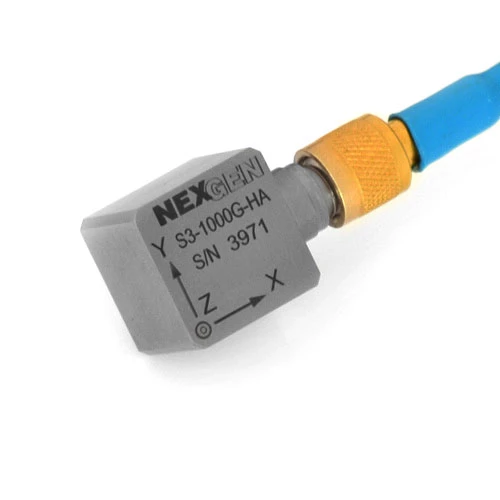
For those tackling heavy-duty industrial vibrations, the S3-1000G-HA Accelerometer provides a robust solution with a range 100 times greater than the ACL300. This powerful device helps you manage and monitor severe vibration environments with confidence and precision.
Product Specifications
Wireless (ACL500)
Wired (ACL300)
Wired (S3-1000G-HA)
Range
± 16G
± 10G / ± 3G / ± 1G
± 1000G
Mass
15g
10g
8g
Dimensions
44 x 24 x 12 mm
19.0 x 12.7 x 10.9 mm (L x D x H)
14 x 13 x 14 mm
Case Material
Acetal
Anodised aluminium
Titanium alloy
Sensitivity
± 100mV / g
± 1mV / g
Cross Talk
± 1º
< 5%
Accuracy
±2.5%
Better than ± 2 % full scale
Bandwidth
DC to 1 KHz (+0 dB/-3 dB)
DC to 100Hz +/- 1dB
DC to 500Hz +/- 1dB
DC to 1000Hz +1dB / – 3dB
DC to 312, 625, 1250, 2500, 5000 Hz
Filter
8 pole, 8th order 1.2 Elliptic
Shock Survival
10,000 g
500 g
5,000 g
Supply Voltage
N/A
+4.50 to +5.50 Vdc
Battery Life
Up to 12 hours
N/A
Battery Type
Rechargeable Li-lon Polymer
N/A
Wireless Transmission Loss
Tolerant for 100 mS
N/A
Range from Interface
Wireless range up to 30m
Cable lengths available: 500mm, 1000mm, 1500mm
(custom lengths available on request)
Our accelerometer sensors come equipped with a unique 8th order 1.2 elliptic filter, designed to strike the perfect balance between pass-band ripple and roll-off steepness, ensuring you capture the clearest, most accurate data. With easily adjustable cut-off frequencies, you can tailor your data collection to the specific requirements of your project.
The following table shows the possible set corner frequencies and the recommended sampling frequency set within the DataLINK or DataLOG to avoid anti aliasing according to the Nyquist Sampling Theorem.
Bandwidth
Minimum Sampling Frequency
per channel of DataLINK or DataLOG
ACL300
DC to 100Hz
200Hz
DC to 500Hz
1000Hz
DC to 1000Hz
2500Hz
S3-1000G-HA
DC to 312Hz
1000Hz
DC to 625Hz
1250Hz
DC to 1250Hz
2500Hz
DC to 2500Hz
5000Hz
DC to 5000Hz
10000Hz
Accelerometer Features
Our accelerometers are crafted with features designed to enhance your data acquisition experience. They offer adjustable frequency response levels, superior noise performance, and high stability under vibration over time. These features ensure that you receive the most accurate, reliable data, even in demanding conditions. The user-selectable corner frequencies provide the flexibility to optimize data capture for your specific application.
3 independent axes - X, Y, Z
Variable full scale measuring range
3 levels of adjustable frequency response
8th order anti-aliasing filter on each channel with user selectable corner frequencies
Low impedance outputs for excellent noise performance
Non critical input power requirements
Electronic calibration adjustments giving high stability under vibration and over time
Signal conditioning electronics housed in a separate small enclosure allowing for miniaturization of the accelerometer probe
Easy interface to many other data acquisition systems
Frequently Asked Questions
The Biometrics Ltd's Accelerometer sensor is designed to provide precise measurements of acceleration in three axes. It is used in a variety of applications, including research, physical assessments, and industrial vibration measurements.
The wireless Accelerometer sensor transmits data wirelessly to a DataLITE interface, allowing for more flexibility and movement during data collection.
The wireless Accelerometer sensor has a wireless range of up to 30 meters.
The wireless Accelerometer sensor has a battery life of up to 12 hours.
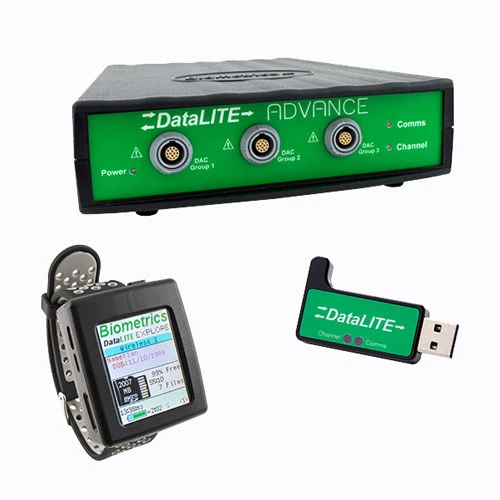
The Accelerometer sensor is compatible with DataLITE PIONEER, ADVANCE, EXPLORE interfaces, as well as DataLOG, DataLINK, Amplifier, or 3rd party interfaces.
There are three different models of the Accelerometer sensor: the wireless model (ACL500), the wired model (ACL300), and a model used for industrial vibrations (S3-1000G-HA).
The range of frequencies that the sensor can precisely measure depends on its bandwidth. Our sensors have a broad bandwidth range, which gives them the flexibility to record various kinds of muscle activity.
Dynamic acceleration refers to the acceleration caused by motion or vibration, while static acceleration refers to the acceleration caused by gravity. The Accelerometer sensor can measure both types of acceleration.
The shock survival of the Accelerometer sensor depends on the model. The wireless model (ACL500) can survive up to 10,000 g, the wired model (ACL300) can survive up to 500 g, and the industrial vibrations model (S3-1000G-HA) can survive up to 5,000 g.
We provide thorough customer service and a two-year warranty for our products.
Compatible Interfaces
Our accelerometers are built to easily integrate into your existing setup. They are compatible with a range of interfaces, including DataLITE PIONEER, ADVANCE, EXPLORE, DataLOG, DataLINK, Amplifier, and even third-party systems. This flexibility allows you to leverage our advanced accelerometers, no matter your current setup.